



Bangladesh’s property market offers two very different paths for investors: buying an apartment for rental income and appreciation, or investing in a hotel or serviced-suite unit for occupancy-based returns. Both can perform well, but they come with different capital requirements, risk profiles, and day-to-day involvement. This guide breaks down the real differences so you can decide which fits your goals, budget, and appetite for management work.
If you want to see live examples of residential investment projects first, you can browse Manzar Properties’ current developments or explore the blog for more market comparisons like this one.
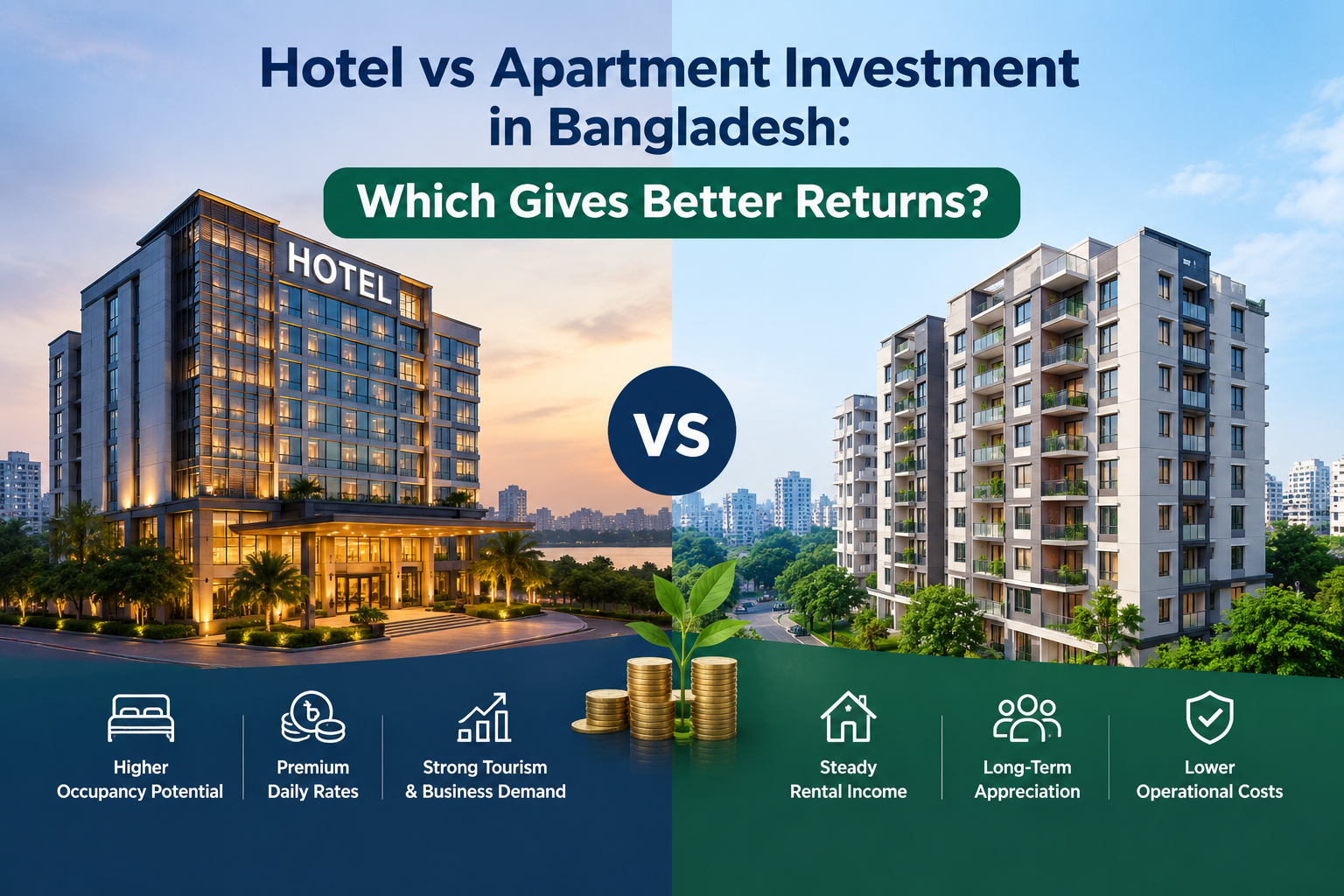
1. Two Different Investment Models
An apartment investment is a long-term residential asset. You buy a unit, either rent it out to a tenant on a monthly or yearly lease, or hold it for capital appreciation. Income is relatively predictable once a tenant is in place, and the asset is easy for most buyers to understand.
A hotel investment — whether a full hotel unit, a serviced apartment, or a share in a branded hospitality project — earns income from short-term guests rather than long-term tenants. Returns are tied to occupancy rates, seasonal demand, and how well the property is marketed and managed, which makes it closer to running a small business than owning a passive asset.
2. Cost of Entry
Apartment investment in Bangladesh generally has a lower and more predictable entry cost. Prices scale fairly directly with location and size, and installment-based payment plans are common, which lowers the upfront barrier. For a sense of current pricing patterns and payment structures across projects, developer comparison guides like Top 15 Developer Companies in Bangladesh (2026) are a useful starting point.
Hotel and serviced-suite investments typically require a higher upfront outlay, since the unit often comes fitted out to hospitality standards (furniture, fixtures, in-room amenities) and may include mandatory participation in a shared management or franchise agreement. Buyers should also budget for ongoing management fees that apartments don’t usually carry.
3. Return on Investment
Apartments generate steady, if modest, rental yields — typically in the range most residential markets in Dhaka support — plus the potential for capital appreciation if the surrounding area develops further. Vacancy risk is lower because tenant leases tend to run for a year or more.
Hotels and serviced units can produce higher returns during strong occupancy periods, since nightly or short-stay rates are usually higher than equivalent monthly rents. But that upside comes with volatility: income drops sharply during low-occupancy seasons, economic downturns, or when new competing properties open nearby. Reviewing a project’s occupancy history — not just its projected returns — is essential before committing.
4. Risk Factors
Apartment investment risk is mostly tied to construction delays, legal documentation gaps, and broader property-market cycles. Buying from a developer with a verified delivery record significantly reduces this risk — see how to vet developers properly in 14 Top Property Developers in Bangladesh.
Hotel investment risk includes all of the above, plus operational risk: management quality, marketing effectiveness, tourism trends, and competition from other hospitality properties in the same area. A well-built hotel unit with poor management can underperform a modest apartment with a reliable tenant.
5. Liquidity and Resale
Apartments are generally easier to resell in Bangladesh because the buyer pool is larger — most middle- and upper-income buyers are looking for a home or a straightforward rental asset, not a hospitality business. Resale value also tends to track the broader neighborhood’s development, which is why location decisions matter so much; this trade-off is explored in more depth here: Plot Size, Location, or Price — How to Decide What Matters Most.
Hotel units are a narrower market. Resale usually depends on finding another investor comfortable with occupancy-based income and any existing management agreement, which can mean a longer time on the market and more negotiating leverage for the buyer.
6. Legal and Regulatory Differences
Both asset types require the same baseline legal diligence — verified land title, RAJUK-approved building plans, and a properly registered sale agreement. Hotel and hospitality projects often add an extra layer: management or franchise contracts, hospitality licensing, and sometimes shared ownership structures for common facilities (lobby, restaurant, conference space).
Before signing anything for either asset type, confirm the deed, khatian, mutation record, and approval documents independently rather than relying on the seller’s summary. If you’re unsure how to interpret any of this, you can reach out directly through Manzar Properties’ Contact page.
7. Management and Involvement
This is one of the biggest practical differences. An apartment, once leased, requires relatively little ongoing management — occasional maintenance, rent collection, and tenant turnover every year or two.
A hotel or serviced unit requires active or semi-active management: pricing adjustments, guest turnover, housekeeping coordination, and marketing, usually handled through a management company in exchange for a percentage of revenue. If you don’t want to be involved in day-to-day operations, that management fee is the cost of staying passive — and it directly eats into your net returns.
8. Financing and Tax Considerations
Apartment purchases are more widely supported by home loan products from Bangladeshi banks, which can improve overall returns through leverage. Hotel and hospitality-unit financing is less standardized and may require a larger cash component or commercial lending terms.
Tax treatment also differs: rental income from a residential apartment is generally more straightforward to report, while hotel-linked income may involve additional business or service-related tax considerations depending on the ownership and management structure. It’s worth consulting a tax professional familiar with Bangladeshi property law before choosing either route.
9. Which Option Fits NRB Investors Better?
For non-resident Bangladeshis, apartments are usually the more manageable choice, since they don’t require active oversight and are easier to hand to a local property manager or family member. If you’re an NRB weighing options, this guide covers the additional considerations specific to buying property from abroad: A Complete Guide to Buying Land in Bangladesh as an NRB.
Hotel investment can still work for NRBs, but only when paired with a management company you trust completely, since you won’t be on the ground to monitor day-to-day performance.
10. Location Still Decides Most of the Outcome
Whichever asset type you choose, location drives both occupancy and resale value more than almost any other factor. Fast-growing planned areas like Purbachal have attracted both residential and hospitality-oriented development as infrastructure catches up with demand. You can see what’s currently being built in the area through Purbachal Yaseen City and Rupnagar Yaseen City, and read more on why the area is drawing investment attention here: Manzar Properties: The Best Real Estate Company in Purbachal.
For buyers weighing Rupnagar specifically, this breakdown is also worth reading: Best Development Company in Rupnagar.
11. Checklist: Apartment vs Hotel Investment
| Factor | Apartment | Hotel / Serviced Unit |
|---|---|---|
| Entry cost | Lower, often installment-based | Higher, includes fit-out |
| Income stability | More predictable | Occupancy-dependent |
| Management involvement | Minimal | Active or fee-based |
| Resale liquidity | Higher (broader buyer pool) | Lower (niche buyer pool) |
| Financing access | Wider bank loan support | More limited, often commercial terms |
| Best suited for | Passive, long-term investors, NRBs | Investors comfortable with active oversight or trusted management |
12. Frequently Asked Questions
Is a hotel investment more profitable than an apartment in Bangladesh? It can be during strong occupancy periods, but returns are far less predictable than apartment rental income, and net profit depends heavily on management quality and location.
Which is safer for a first-time investor — hotel or apartment? Apartments are generally considered the safer entry point because they require less active management and have a larger resale market.
Can NRBs invest in hotel or apartment projects in Bangladesh? Yes, both are open to NRBs, though apartments are typically easier to manage remotely. Legal and documentation steps differ slightly by asset type — see the NRB land-buying guide linked above for the property-purchase side of this.
Does location matter more for hotels or apartments? Both are highly location-sensitive, but hotels are even more exposed to shifts in local footfall, tourism, or business travel patterns, since income depends on consistent guest turnover.
How do I verify a developer before investing in either asset type? Check completed project history, RAJUK approval status, REHAB membership where applicable, and speak with existing tenants or guests before committing. More on vetting developers is covered in Best Real Estate Company in Bangladesh.
For more common questions, visit Manzar Properties’ FAQ page.
13. Conclusion
There’s no universally “better” choice between hotel and apartment investment in Bangladesh — it depends on how much capital you have, how involved you want to be, and how much income volatility you’re willing to accept. Apartments offer steadier, lower-maintenance returns and easier resale. Hotels and serviced units can outperform in the right location with the right management, but carry more operational risk and a narrower resale market.
Whichever path you’re considering, start with the same fundamentals: verified land title, approved building plans, a developer with a real delivery record, and a location with genuine long-term growth potential. To talk through your specific goals or see current residential investment options, explore Manzar Properties’ projects, learn more about the company and team, or get in touch directly.